
Got Milk? Maybe You Shouldn’t
Apparently my little dig at dairy didn’t go unnoticed. You asked why I wasn’t on board. Here ya go!
Let me start by saying that I find dairy one of the most confusing topics about nutrition. There’s not a definitive consensus on many of the issues involving dairy and research is more limited than you’d think. My issue is less with dairy itself, and more with the huge dairy-is-essential messages we’ve been receiving since we were kids.
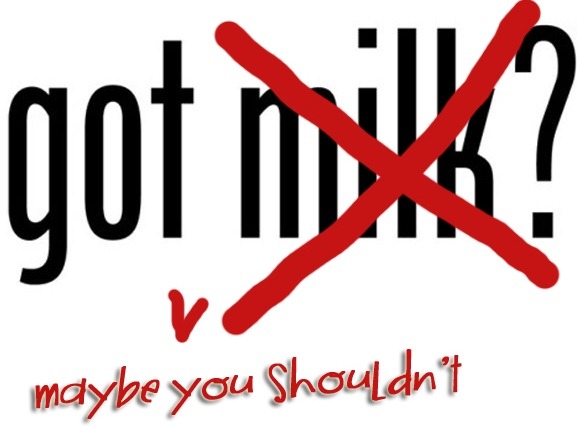

We are a milk-free household. I drink almond or coconut milk and the husband drinks soy milk. While we’re milk free, we’re not an entirely dairy-free family. The husband eats cheese and pre-allergies I ate the occasional Greek yogurt, goat cheese, or Moe’s queso, as I’ve probably mentioned 135,938 times. What I’m saying is, I’m not telling you that you have to shun dairy- let’s just get educated so you can make the best choices for you and your family.
There’s no way I can cover every aspect of dairy and every side of the story in a single post, so I’m going to do my best to hit on a couple points about the dark side of dairy- the parts most people don’t know much about. This is not all encompassing by any means!!
Why Dairy Isn’t All It’s Cracked Up to Be
– Exposure to dairy before the age of 1 is correlated with type 1 diabetes
– One of the proteins in dairy, casein, is associated with increased rates of cancer
– The sugar in dairy, lactose, is related to ischemic heart disease. Many, many people have trouble digesting this sugar.
– Milk consumption is linked to bladder, colorectal, prostate, and testicular cancers
– Dairy is the highest source of dioxin in the standard American diet, found in especially high levels in butter and cheese. Dioxin is a toxic chemical that can cause cancer.
– Consumption of milk protein can increase levels of IGF-1 {insulin-like growth factor} in the body, which promotes the growth of cells- both normal and cancerous.
– Dairy has been linked to a number of autoimmune diseases such as rheumatoid arthritis, fibromyalgia, lupus, multiple sclerosis, Graves’ disease, and type 1 diabetes. {The proposed theory here is that some people’s bodies cannot distinguish the difference between cow’s milk proteins and their own proteins.}
– Dairy is “mucus-producing”- this can cause built up phlegm, acne, eczema, and psoriasis.
– Dairy products may contain hormones {even if “organic”} and promote increased level of hormone production in the body.
– Not only is milk not the only good source of calcium, but it does not prevent osteoporosis. In fact, the it can play a role in the destruction of bone due to the acid load and erosion of bone-building cells.

Although these things have been shown in research, it still leaves a lot of unanswered questions and conflicts among other studies. There is evidence that low-fat dairy products and yogurt increase fat loss. There’s no argument that the probiotics in dairy and other cultured/fermented products are beneficial to the gut and immune system. Whey and casein {dairy proteins} are beneficial proteins for recovery in sports nutrition. So where does that leave us? Good question!
If all this leaves you confused, you’re not alone. Wondering if you should or shouldn’t be eating dairy? While some of these things would require a glass ball into the future, other things can easily be deciphered. Stop eating dairy for a month. How do you feel? The same? Then eat dairy. Better? Cut it out or limit it. Worse? Hmmmmmm. I can’t tell if I’m reducing my cancer risk by how I feel, but it’s extremely clear to me that my stomach issues are minimized when I cut back the dairy.
The same strategy can be used for any “trend”- gluten, vegetarian, etc. Listen to your body and make your OWN decisions.
For me, I worry more about dairy because of my son’s allergy to it: where did it come from? Why does he have it? I also worry about it because of the mysterious pain condition I struggled with for a few years {and still do to some extent} and dairy’s relationship to autoimmune disorders. Decreasing the dairy I consumed made an impact on my pain level, which pretty much blows my mind.
For more reading: resources on dairy.
What do you think about dairy?


